
 By
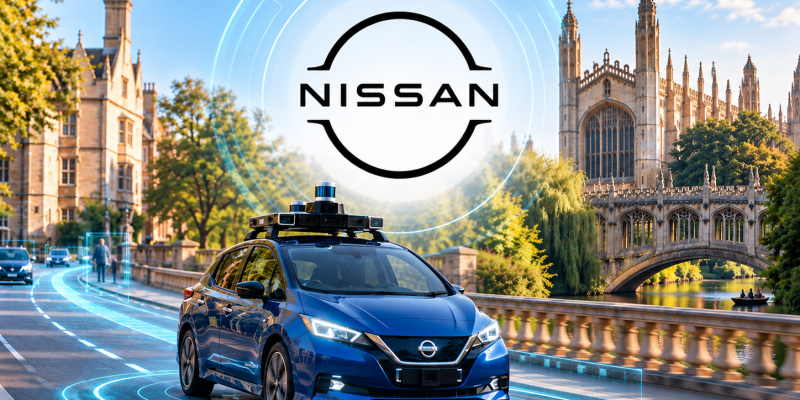
Nissan is taking another step toward bringing autonomous driving into everyday transportation with the launch of ADventure, a government-backed research initiative that will test self-driving mobility services in Cambridge, UK. Rather than focusing exclusively on the technology behind driverless vehicles, the project aims to understand how autonomous transportation could address practical mobility challenges and improve accessibility for local communities.
The initiative is supported by a £3 million UK government-backed research programme, bringing together Nissan, Warwick Manufacturing Group (WMG) at the University of Warwick, and PAVE UK (Partners for Automated Vehicle Education UK). Cambridge will serve as the first real-world testing environment, providing an opportunity to examine how autonomous passenger services could operate alongside existing urban transportation networks.
At the centre of the project is a specially adapted 2022 Nissan LEAF electric vehicle, equipped for autonomous driving research. Engineers from Nissan Technical Centre Europe will lead the technical development, drawing on more than a decade of the manufacturer’s experience in autonomous vehicle technology. The trial will examine how self-driving systems perform in an urban environment while taking into account the needs of commuters, residents and local authorities.
One of ADventure’s defining objectives is to explore the social benefits of autonomous mobility. Nissan has highlighted scenarios such as helping elderly residents or people who cannot drive reach medical appointments. By investigating these real-world journeys, the project seeks to determine whether autonomous services could complement public transportation and provide greater independence to people facing mobility barriers.
Beyond the vehicle itself, ADventure will investigate the broader requirements for introducing autonomous passenger services into communities. This includes understanding how local transportation needs, public acceptance and operational considerations influence the deployment of driverless mobility. Collaboration with residents and local authorities will be central to developing a service model that could eventually be adapted to other UK cities.
The initiative builds on Nissan’s previous autonomous driving research, including the HumanDrive, ServCity and evolvAD programmes. These projects have helped the manufacturer investigate autonomous vehicle performance across different driving environments, from complex city streets to residential and rural roads. ADventure represents a further shift toward exploring how this technology could become a practical mobility service rather than remaining primarily a research demonstration.
For the wider automotive technology industry, the Cambridge pilot illustrates the growing importance of combining autonomous driving software with service design and real-world deployment strategies. As manufacturers move closer to introducing driverless transportation, the challenge extends beyond enabling vehicles to navigate independently: it also involves building mobility services that are accessible, reliable and suited to the communities they are intended to serve. Nissan hopes the findings from Cambridge will provide a blueprint for future autonomous mobility deployments across the UK.









Comments