
 By
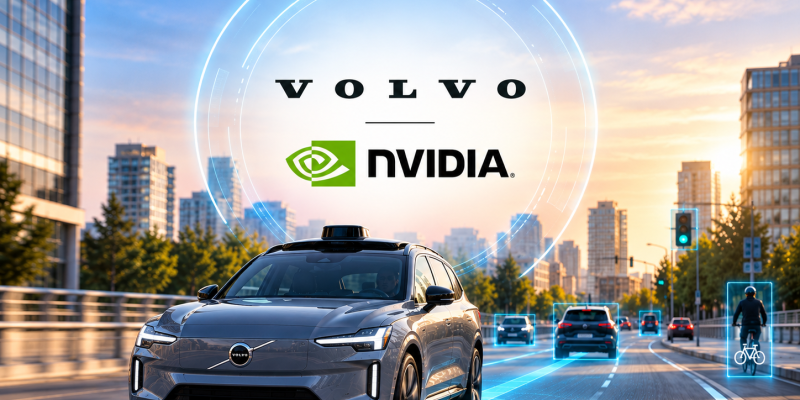
Volvo Cars is expanding its partnership with Nvidia to develop a new generation of AI-powered driving assistance capable of navigating complex urban environments with minimal driver intervention. The Swedish automaker plans to introduce hands-free, point-to-point driving before the end of the decade, bringing advanced automation beyond highways and into everyday city traffic.
The upcoming system will offer what Volvo describes as Level 2++ automated driving, enabling vehicles to handle challenging situations such as traffic lights, stop signs and unprotected left turns without continuous steering or pedal input from the driver. Similar in ambition to Tesla’s Full Self-Driving (Supervised), the technology will remain a driver-assistance system rather than fully autonomous driving. Drivers will still be responsible for monitoring the road and intervening when necessary.
At the heart of the project is Nvidia’s Hyperion autonomous driving platform, combining powerful onboard computing with an array of sensors designed to monitor the vehicle’s surroundings. Volvo will also integrate Nvidia’s Alpamayo software, which uses AI reasoning models to interpret complex road situations and determine appropriate driving actions. Rather than relying solely on predefined driving rules, the technology aims to help vehicles understand changing traffic conditions and make more sophisticated decisions about steering, acceleration and braking.
Interestingly, the initial architecture will not include lidar sensors, although Volvo has left open the possibility of introducing the technology in future versions. The approach follows changes to Volvo’s earlier autonomous driving plans, including the suspension of its Level 3 Ride Pilot ambitions in the United States amid regulatory challenges. By concentrating on advanced supervised automation, Volvo is pursuing a more immediately deployable route toward increasingly capable self-driving technology.
Safety will remain a central element of the partnership. Volvo intends to combine Nvidia’s autonomous driving capabilities with its own driver-understanding technology, which evaluates driver behaviour and engagement beyond conventional monitoring systems. The manufacturer will also draw on its connected safety infrastructure, allowing vehicles to exchange information about road hazards, construction zones and changing conditions. Such data could extend the system’s awareness beyond the immediate range of its onboard sensors, supporting more informed driving decisions.
The company intends to make the technology available across its vehicle portfolio, from entry-level models to premium offerings, although it has not yet confirmed which vehicles will receive the system first. Volvo’s target is to introduce the functionality before 2030, positioning it among automakers seeking to deliver advanced point-to-point driving assistance across a broader range of road environments.
Beyond the technical capabilities, the collaboration also highlights the growing commercial importance of automotive software. Nvidia sees sophisticated urban driving assistance as a potentially more valuable offering than highway-only automation, opening opportunities for manufacturers to introduce new software-based services throughout a vehicle’s lifecycle. For Volvo, the partnership represents a significant step toward combining AI, connected vehicle intelligence and its established safety expertise to create a more capable software-defined driving experience.






Comments