
 By
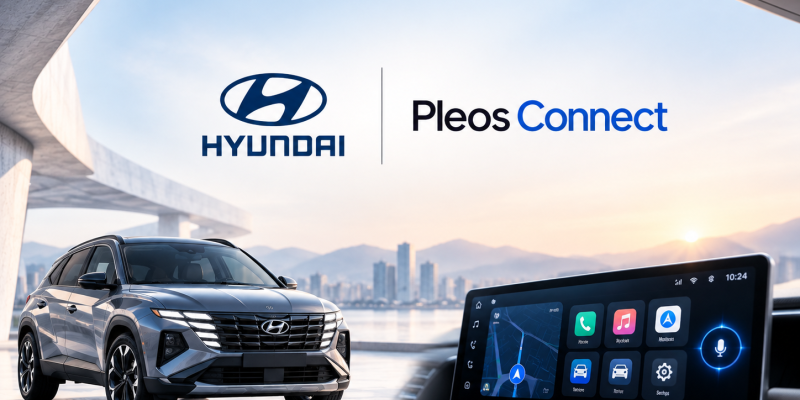
Hyundai is preparing to introduce its next-generation Pleos Connect infotainment platform to the United States with the launch of the redesigned 2027 Tucson. The SUV will become the first Hyundai model sold in the American market to feature the new system, marking a significant step in the automaker’s transition toward software-defined vehicles and more personalized digital experiences.
Built on Android Automotive OS, Pleos Connect introduces a new infotainment architecture designed to support native applications, connected services and over-the-air software updates. The platform will be available with 12.9-inch and 17-inch center displays, offering a customizable interface developed around three principles: intuitiveness, safety and openness. Hyundai aims to make the vehicle’s digital environment easier to navigate while allowing its capabilities to evolve throughout the ownership experience.
One of the platform’s central features is Gleo AI, Hyundai’s new generative AI-powered in-vehicle assistant. Using large language model technology, the system can interpret conversational requests, understand context and respond to multiple instructions during a single interaction. Drivers will be able to search for destinations, request navigation guidance, adjust climate settings and access vehicle information through natural-language conversations rather than relying exclusively on predefined commands.
Navigation is another important component of Pleos Connect. The platform integrates HERE Maps and Google Places, combining routing capabilities with location search and contextual information. Preinstalled map data will help maintain navigation functionality in areas with limited connectivity, while floating information cards allow drivers to view route details without obstructing the main map. The interface also supports portrait and landscape orientations and compatible applications running simultaneously.
Hyundai is also introducing the Pleos App Market, a dedicated marketplace that allows drivers to download applications directly to the vehicle. The ecosystem will cover entertainment, music, lifestyle, productivity and mobility services, with individual applications receiving updates independently of the vehicle’s broader infotainment software. Hyundai is developing an API for third-party developers, creating opportunities for additional services while maintaining cybersecurity and application verification requirements.
Despite adopting a native Android Automotive architecture, Hyundai will continue supporting wireless Apple CarPlay and Android Auto, giving customers the flexibility to access smartphone-based services alongside the vehicle’s built-in applications. The platform also incorporates Bluetooth 5.4 and Wi-Fi 6 connectivity, reinforcing Hyundai’s strategy of combining native digital services with familiar smartphone ecosystems.
The introduction of Pleos Connect in the Tucson represents the beginning of a much larger deployment. Hyundai is targeting approximately 20 million vehicles equipped with Pleos Connect by 2030, using software updates, connected vehicle data and AI capabilities to continuously improve the customer experience. As automakers increasingly compete through software ecosystems rather than hardware alone, Hyundai’s approach highlights the growing importance of in-car app distribution, conversational AI and long-term digital services in mainstream vehicles.






Comments