
 By
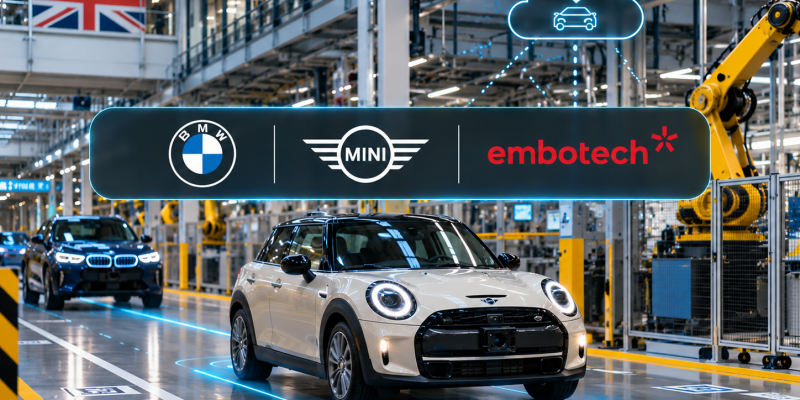
BMW Group has reached a major milestone in automated vehicle production, completing one million driverless vehicle movements across its manufacturing network. Announced on October 27, 2026, the achievement coincides with the expansion of its Automated Driving In-Plant (AFW) technology to MINI Plant Oxford, making it the fourth BMW Group facility to adopt the system.
Originally introduced as a pilot project at BMW’s Dingolfing plant in 2022, AFW allows newly manufactured vehicles to navigate designated production and logistics areas without a driver behind the wheel. The technology is now operating at Dingolfing, Leipzig, Regensburg and Oxford, handling approximately 3,500 automated vehicle movements daily across the network. MINI Plant Oxford alone has recorded more than 53,000 movements over the past year.
Unlike conventional autonomous driving systems that rely primarily on sensors installed inside the vehicle, BMW’s approach uses external LiDAR sensors integrated into factory infrastructure. Combined with cloud-based architecture and advanced motion-planning software, these sensors continuously monitor the surrounding environment and guide vehicles along predefined routes. This infrastructure-based approach enables different vehicle models to operate autonomously regardless of their onboard equipment specifications.
The system can also respond dynamically to pedestrians, other vehicles, logistics equipment and temporary obstacles encountered within production facilities. Artificial intelligence supports its development, simulation and operation, helping engineers test new capabilities and improve performance. BMW developed the technology in collaboration with Swiss software company Embotech, which specializes in automated vehicle movement and industrial mobility solutions.
At MINI Plant Oxford, BMW has taken integration a step further by connecting automated vehicle movements directly to existing factory control systems. Vehicles can position themselves precisely beside lifting equipment, enabling production operations to take place through coordinated, cloud-based interactions. This illustrates how autonomous driving technology can become part of a wider connected manufacturing ecosystem rather than operating as a standalone solution.
The technology is also demonstrating its potential for industrial-scale deployment. According to Embotech, the system operates around the clock across BMW’s four participating factories, achieving availability above 99.5%. BMW plans to continue its international expansion, with its Spartanburg manufacturing plant in South Carolina scheduled to introduce AFW in 2027.
For BMW, the milestone reinforces its broader iFACTORY strategy, which focuses on digitalization, automation and intelligent connectivity throughout vehicle manufacturing. While autonomous driving development is often associated with public-road applications, BMW’s experience demonstrates how the technology is already delivering practical benefits in controlled industrial environments, potentially establishing new standards for automated automotive production and logistics.









Comments