
 By
By 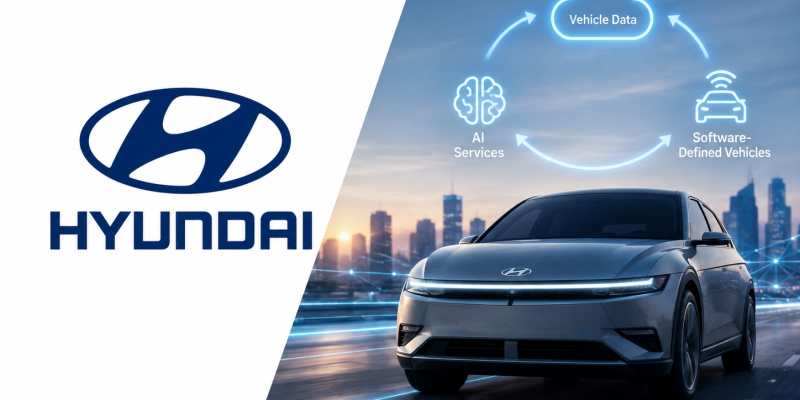
Hyundai Motor Group is building what it calls a “data flywheel”, using information continuously collected from its global vehicle fleet to accelerate the development of software-defined vehicles. The strategy will feed vehicle data back into Hyundai’s software ecosystem, enabling improvements to autonomous-driving technology, AI services and infotainment through over-the-air updates.
The first stage will begin in South Korea with Hyundai’s flagship Grandeur, equipped with the Pleos Connect infotainment platform and Gleo AI, the group’s new generative AI in-car assistant. Data gathered from Hyundai and Kia vehicles will initially be used to improve Gleo AI and develop additional infotainment features.
Gleo AI is initially being positioned around vehicle controls and convenience functions, but Hyundai plans to connect the assistant with additional application services over time. This makes fleet data particularly important: interactions and vehicle information can contribute to a continuous feedback loop in which AI models and digital services improve as more connected vehicles join the ecosystem.
Hyundai is also standardizing its vehicle sensor architecture around Nvidia’s ecosystem. The goal is to allow data collected across Hyundai, Kia, software subsidiary 42dot and autonomous-driving company Motional to be used consistently, creating a common technological foundation for future SDVs.
Autonomous driving represents another major part of the strategy. Hyundai plans to introduce Level 2+ capabilities in its first mass-produced SDV in 2028, while data collected from vehicles will help train and improve Atria AI, the end-to-end autonomous-driving system developed by 42dot. The technology is eventually expected to operate across millions of Hyundai Group vehicles.
Supporting this enormous flow of information will require significant computing capacity. Hyundai is bringing online the 100MW Saemangeum AI Data Center in South Korea, designed to accommodate more than 50,000 GPUs. The company expects the volume of autonomous-driving data generated by its connected fleet to increase rapidly from 2029.
For Hyundai, the connected vehicle is therefore becoming more than an endpoint for software. Each car becomes part of a continuously evolving data network, helping improve AI assistants, infotainment applications, autonomous-driving systems and future digital services across the fleet — a model that could become increasingly central to the economics of the software-defined vehicle.







Comments